 Detectamet UK (English - £ GBP) - Click here to change your currency, region or language

Education
-
 Read more »
In an industry where consumer trust is paramount, ensuring the safety and quality of food products is not just a regulatory requirement but a moral imperative. Every step, from sourcing raw materials to final packaging, is scrutinized to prevent contamination. Among the most critical safeguards in modern food processing are metal detection and X-ray inspection systems, acting as vigilant guardians against foreign body contamination. However, the effectiveness of these advanced technologies hinges on one often-overlooked, yet absolutely crucial, aspect: calibration standards.
-
Posted: January 21, 2025Categories: Education
 Read more »
Everyone who works in food production understands the key role PPE (Personal Protective Equipment) plays in both worker safety and maintaining hygiene standards in food safety. Yet, maintaining these high standards often means finding a balance between comfort and functionality in the use of PPE.
For food processing businesses, this balance is more than a nice-to-have, it’s a necessity. Uncomfortable or inadequate PPE can compromise worker compliance, productivity and, ultimately, food safety.
Let’s look at the unique challenges of selecting PPE for food processing environments, highlighting the importance of detectability, comfort and function.
The Dual Role of PPE in Food Processing
PPE in food processing serves two primary purposes:
1: Protecting workers from workplace hazards.
2: Safeguarding food products from contamination.This dual role makes the selection of effective PPE particularly challenging because food processing environments often involve:
-
Exposure to wet or cold conditions.
-
-
Posted: January 07, 2025Categories: Education
 Read more »
No one plans for a food contamination event and product recalls!
Each January, food manufacturers around the world set ambitious goals for growth and success. They should also factor into their plans the need to avoid food contamination and product recalls. The damage caused by such events doesn’t just endanger the health of your consumers and impact your bottom line in the short term; it can irreparably harm your brand's reputation.You’ve probably read about recent high-profile cases where foreign matter, namely fragments of metal, were discovered in frozen chicken nuggets, bagels and granola bars. We won’t name names - because these brands have suffered enough damage - instead, put yourself in their shoes. Imagine discovering that a customer has found a foreign object in your product. Now imagine the cascade of consequences: pulling products off shelves, issuing apologies, dealing with both financial and reputational fallout. And that’s if you’re fortunate enough to have caught it before
-
Posted: December 16, 2024Categories: Education
 Read more »
Ensuring traceability and compliance is essential for food manufacturers aiming to protect their consumers, brand and bottom line. In the complex arena of food production, maintaining complete oversight of every product batch, from raw material to final shipment, is no easy task.
That’s where sequential numbering comes in. By attributing a unique, traceable code to every batch, item or production cycle, food manufacturers can track products at every stage of the supply chain. This enables faster recalls, more accurate reporting and improved compliance with regulatory standards like HACCP, FDA and EU regulations.
In this guide, we’ll explore:
What sequential numbering is
Why it matters for food processors
How Detectamet supports sequential numbering with detectable products
Read on to strengthen your food safety processes, stay ahead of audits and improve traceability.
What is sequential numbering in food manufacturing?
So, let’s start at the top by understanding sequential numbering within
-
Posted: December 10, 2024Categories: Education
 Read more »
In the food production and processing industries, we all know that regulatory bodies play a critical role in ensuring the quality and safety of food products for consumers while helping businesses remain compliant and efficient.
It’s important to remember that the regulatory bodies shouldn’t be seen as simply generating red tape designed to tangle up food processing businesses. Instead, they should be welcomed as partners who are helping to raise and maintain standards and ensure the customers receive the best possible food, so the producers of that food enjoy a lucrative business future.
At Detectamet, we didn’t get to be a global leader in detectable products for food safety by ignoring the importance of validation and regulation. Adherence to appropriate regulations is central to our mission.Let’s cast a light onto the key regulatory bodies and frameworks shaping food hygiene standards globally, the role of validation and why regulation is essential for safeguarding consumers and supporting
-
Posted: November 05, 2024Categories: Education
 Read more »
Personal Protective Equipment (PPE) is a critical component in ensuring the safety of both your workers and your consumers, as well as for maintaining the integrity of your products. However, misuse and misunderstanding of PPE can lead to contamination, injury and regulatory non-compliance.
So, let’s look at some of the more common PPE mistakes in food processing and provide practical tips on how to avoid them.Basic principles of PPE in food processing
Let’s start with the essentials for effective PPE management in food manufacturing settings:
1. Adequate trainingMistake: Workers may not fully understand why PPE is important or how to use it correctly.
Solution: Implement comprehensive training programmes that cover the importance of PPE, how to wear it correctly and when to replace it. Regular refresher courses can help reinforce these concepts.
2. Proper fitting
Mistake: Ill-fitting PPE can be uncomfortable which can lead workers to use it improperly or even to abandon using it,
-
Posted: October 22, 2024Categories: Education
 Read more »
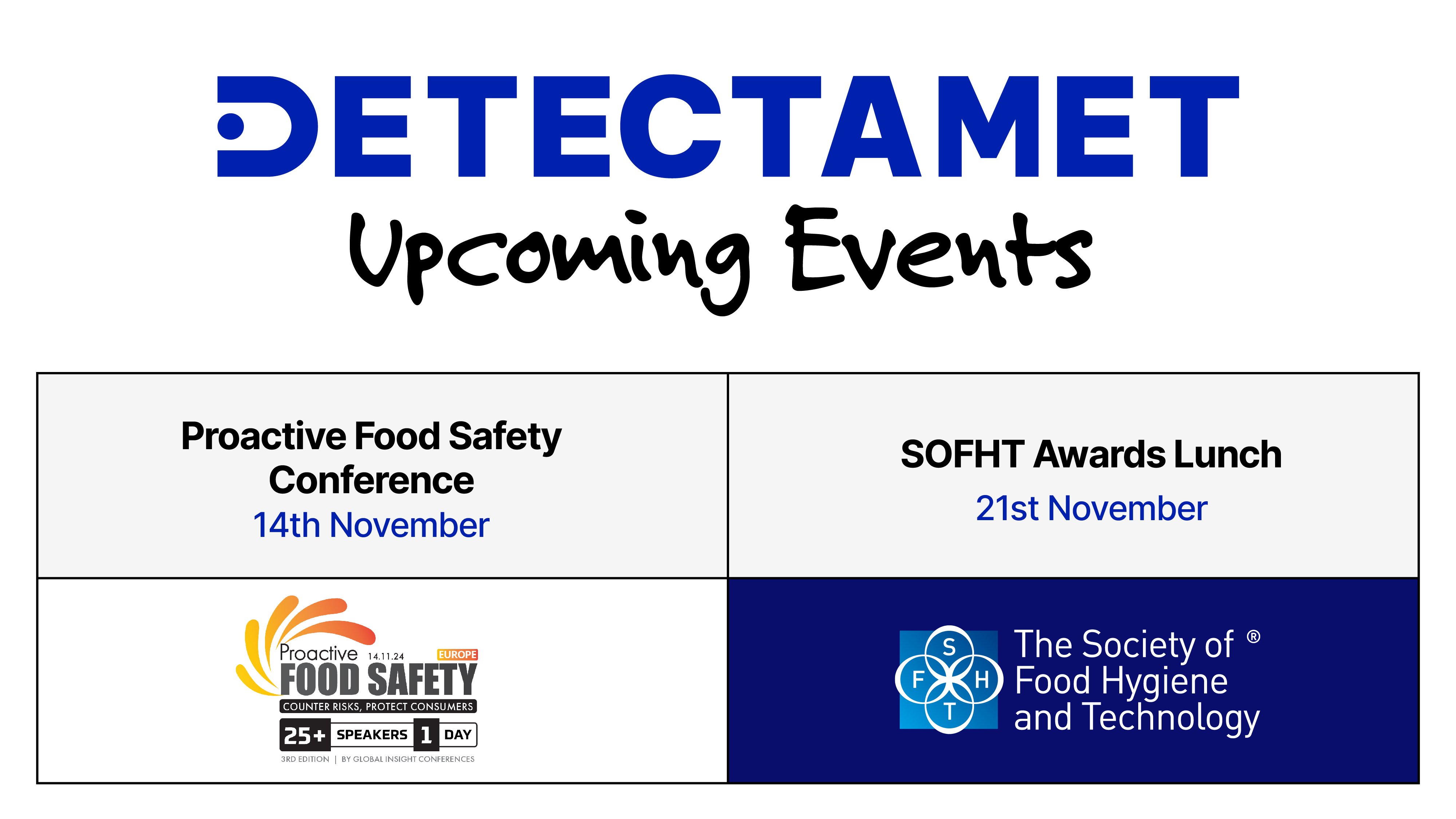
At Detectamet, we thrive on attending live events. These provide unrivaled opportunities for networking and collaboration with leading businesses in the food safety and processing industries. By engaging with other industry pioneers, we exchange ideas, share innovations and keep Detectamet at the cutting edge of industry trends and technological advancements.
Our presence at these events also gives you the opportunity to experience Detectamet’s world-leading Metal Detectable & X-Ray Visible Products firsthand. You’ll get to see our solutions in action and explore how they can enhance safety and compliance in your operations.
When you visit the DetectaTeam at any of these events, you can expect:
- Free Sample Packs: Get hands-on experience with the quality and reliability of our market-leading products.
- Cutting-Edge Solutions: Discover a comprehensive range of products designed to reduce foreign matter contamination risks and improve food safety.
- Expert Insights: Our knowledgeable DetectaTeam
-
Posted: October 11, 2024Categories: Education
 Read more »
Since food safety is one of the most critical responsibilities for any food processing facility, performing regular and rigorous food safety audits is an essential safeguard.
In an industry where foreign matter contamination can result in severe health consequences and damage to a brand’s reputation, it’s essential that every business takes this process seriously.
Especially since external auditors can arrive unannounced. Depending on your location and your business sector, an external food safety audit can be anywhere from every six months to every two years. So, you need to be ready.By conducting regular internal audits, businesses can maintain compliance with stringent food safety standards, protect consumers from harm and help to ensure there are no issues when the external auditors arrive.
So, let’s explore the importance of good food safety audits and take a step-by-step guide to conducting yours smoothly and effectively.Why food safety audits are essential
Food safety audits are
-
Posted: October 04, 2024Categories: Education
 Read more »
The history of food safety has been one of manufacturers versus contaminants. As such, food hygiene has always been a crucial concern in food manufacturing. Since your products are going to be eaten or drunk by customers, you have to ensure the user will come to no harm.
The methods used to ensure food safety have evolved significantly over time. From the early days of basic hygiene to today’s highly-regulated and technology-based systems, the journey of food safety reflects the growing complexity of our food supply chain.
As our understanding of contamination risks has deepened, so too has our commitment to ensuring that the food reaching consumers is free from harm.
The introduction and evolution of detection technologies, such as metal detectors and X-ray systems, revolutionised food safety practices and are now essential tools in protecting both consumers and brands.
So, let’s explore the evolution of food safety, focusing on how metal detectors and X-ray machines have transformed the -
Posted: October 03, 2024Categories: Education
 Read more »
Before processed, packaged and manufactured food goods arrive on consumers' plates, they undergo stringent processing workflows and regulations to ensure safety. Like a knife and fork, safety and tasty should always go hand in hand.
However, as history has shown, breakdowns in these processes can sometimes result in food products becoming contaminated. The last thing any food manufacturer wants is for a foreign object to find its way into a product. After all, physical contaminants not only threaten consumer safety but can trigger widespread product recalls, resulting in costly business disruptions.
To help mitigate these risks, our food safety experts have identified the six most common physical contaminants found in food processing and outlined how you can safeguard your products against them.
#1 Metal contaminants
Metal contamination is a significant concern in food processing, often originating from the very equipment which is processing the food. Machinery, cutting tools and utensils